Industrial Freight Elevator Solutions for Modern Facilities
Factories, warehouses and logistics centers often need to move materials between different floors. When cargo is heavy, oversized or transported frequently, ordinary passenger elevators are usually not designed for the task.
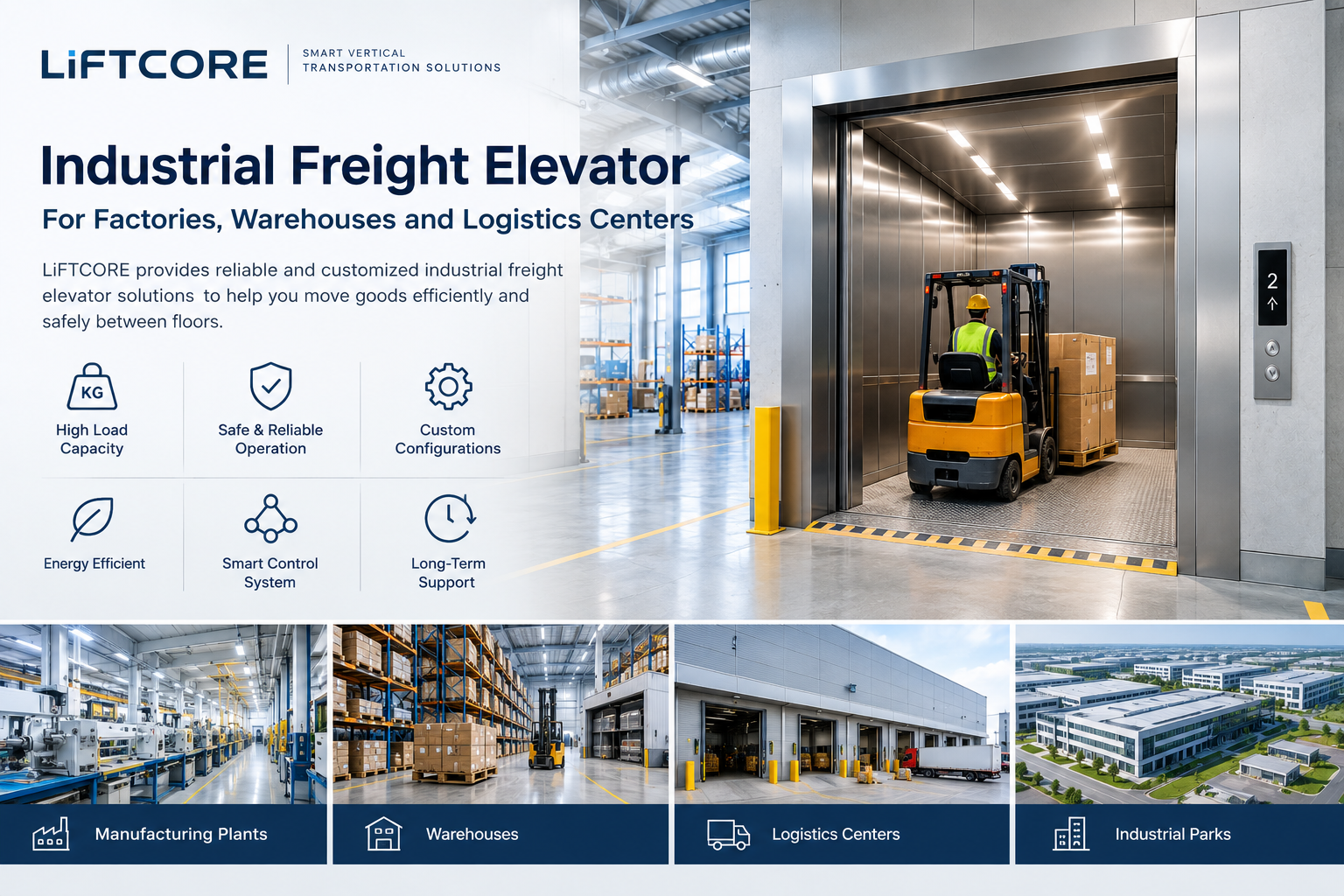
An Industrial Freight Elevator is designed for demanding material-handling environments where load capacity, durability, cabin dimensions and operational stability are important.
LiFTCORE’s smart factory solutions cover automated warehouses, manufacturing plants, industrial parks and large logistics centers, with vertical transportation designed to connect different stages of industrial logistics.
What Is an Industrial Freight Elevator?
An industrial freight lift is a vertical transportation system primarily used to move goods, equipment, production materials and other cargo between floors.
Compared with passenger-focused equipment, freight systems generally place greater emphasis on structural strength, loading conditions, cabin dimensions and repeated operation.
A suitable Industrial Freight Elevator should be selected according to the actual cargo, building structure and workflow rather than using a single standard configuration for every facility.
Freight Elevators for Manufacturing Plants
Manufacturing facilities may need to move raw materials, components, machinery and finished products between production areas.
A properly configured freight lift can connect different production levels and improve the movement of materials within the building.
Before selecting equipment, manufacturers should consider cargo weight, pallet dimensions, loading equipment, door size and operating frequency.
Key Requirements for Factory Applications
- Suitable load capacity
- Durable cabin construction
- Appropriate door dimensions
- Stable operation
- Easy loading and unloading
- Suitable control configuration
- Safety protection for industrial use
Freight Elevators for Warehouses
Modern warehouses increasingly use multi-level storage to make better use of available floor space. This creates a need for reliable vertical cargo transportation.
An Industrial Freight Elevator can connect storage floors, sorting areas, loading zones and dispatch areas.
For automated warehouses, the equipment may also need to coordinate with pallet handling systems, automated shelves or mobile transport equipment.
LiFTCORE’s smart factory platform describes AGV and RGV compatibility, supporting automated material handling between different floors.
Heavy-Duty Applications
Some industrial projects involve machinery, steel structures, production equipment or oversized components that require significantly higher capacity.
In these environments, the elevator cabin, structure, doors and control system need to be engineered around the cargo characteristics.
LiFTCORE has also developed an 18-ton passenger and freight elevator for oversized and heavy equipment transportation. The solution is designed for applications including manufacturing plants, logistics facilities, amusement parks and other heavy-duty environments.
Customization for Industrial Applications
A major advantage of working with an experienced Industrial Freight Elevator supplier is the ability to adapt the equipment to the project.
Potential customization areas include:
- Rated load
- Cabin size
- Door width and height
- Cabin materials
- Control systems
- Operating speed
- Safety systems
- Dust-resistant design
- Corrosion-resistant options
- Special industrial requirements
LiFTCORE’s published freight elevator solutions also describe customization for demanding industrial environments, including dust-proof, anti-corrosion and other specialized configurations.
Industrial Freight Elevators in Industrial Parks
Large industrial parks may contain multiple production buildings, warehouses and supporting facilities. Efficient internal logistics becomes increasingly important as these sites grow.
An Industrial Freight Elevator can support material movement between production floors and storage areas while becoming part of a broader logistics system.
LiFTCORE has supplied 59 customized freight elevators for a manufacturing park in Foshan covering approximately 40,000 square meters and including multiple production buildings.
This type of project shows why elevator design should be based on the specific operating conditions of the facility.
Industrial Freight Elevator and Smart Logistics
Industrial logistics is becoming increasingly connected. Automated guided vehicles, warehouse management systems and intelligent scheduling can work together to improve material flow.
The vertical transportation system can become another connected part of this process.
LiFTCORE’s smart factory solution includes centralized management, intelligent scheduling, IoT-based remote diagnostics and compatibility with AGV and RGV systems.
For large manufacturing and warehouse projects, these functions can help connect vertical cargo transportation with the wider logistics workflow.
How to Select the Right Equipment
Before purchasing an Industrial Freight Elevator, project teams should define several technical parameters:
- Maximum cargo weight
- Cabin dimensions
- Door dimensions
- Number of floors
- Travel height
- Required speed
- Loading method
- Forklift or pallet truck access
- Daily operating frequency
- Environmental conditions
These details allow the manufacturer to recommend an appropriate configuration and avoid unnecessary modifications later in the project.
Applications Across Different Industries
Heavy-duty cargo elevators can be used in a wide range of industrial environments, including:
- Manufacturing plants
- Factories
- Automated warehouses
- Logistics centers
- Industrial parks
- Automotive facilities
- Power plants
- Shipbuilding facilities
- Heavy equipment facilities
- Mining-related operations
The required specifications can vary significantly between industries, so engineering evaluation remains an important part of the selection process.
Safety and Long-Term Reliability
Industrial elevators can operate under demanding conditions and may experience frequent loading and unloading. Structural strength, control accuracy, door performance and safety systems therefore require careful consideration.
LiFTCORE’s published industrial freight solutions describe reinforced structures, high-load configurations and technical solutions designed for demanding cargo transportation applications.
Project owners should also consider maintenance access, spare parts and technical support when evaluating long-term equipment performance.
Why Choose LiFTCORE?
LiFTCORE provides vertical transportation solutions for factories, warehouses, manufacturing plants, industrial parks and large logistics facilities.
The company’s smart factory platform combines industrial elevators, smart control systems and customized industrial cabins for different logistics scenarios.
Its published project experience also includes customized freight elevator solutions for large industrial parks and heavy-duty passenger and freight transportation.
For international industrial projects, this combination of elevator engineering, manufacturing and smart logistics technology can support more complex vertical transportation requirements.
Conclusion
An Industrial Freight Elevator can play an important role in factories, warehouses, logistics centers and manufacturing parks where materials need to move efficiently between different floors.
The right solution should be selected according to cargo weight, cabin dimensions, building structure, operating frequency, loading method and environmental conditions.
LiFTCORE provides customized freight and industrial vertical transportation solutions designed around the requirements of modern manufacturing and logistics facilities.
Frequently Asked Questions
What is an Industrial Freight Elevator used for?
It is mainly used to transport materials, equipment, pallets and other industrial cargo between different floors.
Can freight elevators be customized?
Yes. Capacity, cabin dimensions, doors, speed, control systems and certain environmental protection features can be customized according to project requirements.
Can an industrial elevator work with automated logistics?
Depending on the configuration, the elevator can be integrated with automated material-handling equipment such as AGV and RGV systems.
What industries use freight elevators?
Common applications include manufacturing, warehousing, logistics, automotive production, industrial parks, heavy equipment and other industrial facilities.
What information is needed for a freight elevator project?
The supplier normally needs cargo weight, cabin size, door dimensions, number of floors, travel height, loading method, operating frequency and environmental conditions.