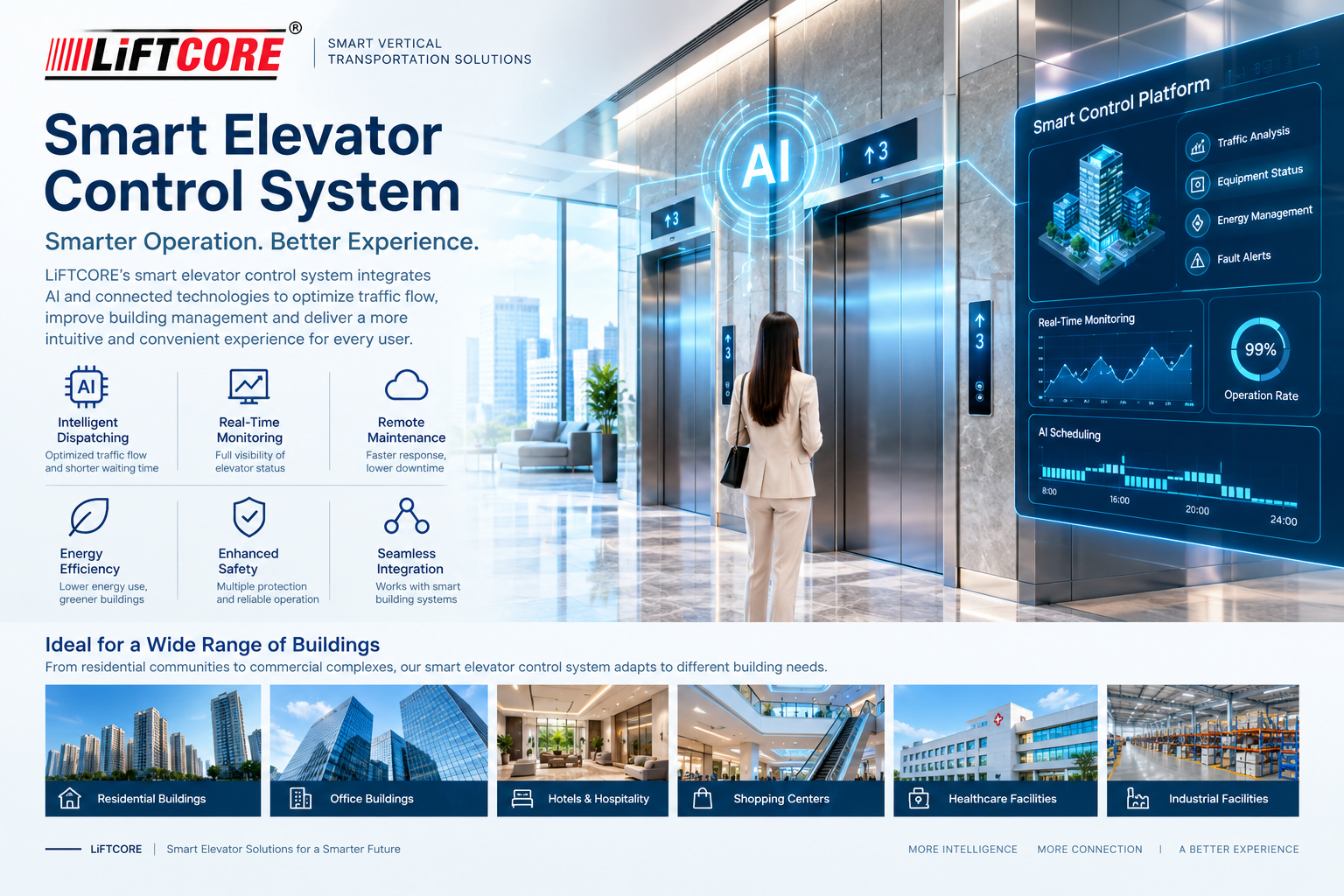
Why Smart Elevator Control Systems Matter
Elevators are an important part of modern buildings, but simply moving passengers between floors is no longer the only requirement. Residential communities, office buildings, hotels, healthcare facilities and commercial complexes increasingly need smarter ways to manage vertical transportation.
A Smart Elevator Control System can connect elevator operation with intelligent control, monitoring and building management functions. By using digital technologies, building operators can gain better visibility into elevator performance while creating a more convenient experience for passengers.
LiFTCORE integrates intelligent technologies into its elevator solutions to support more efficient, reliable and connected vertical transportation.
What Is a Smart Elevator Control System?
A Smart Elevator Control System is an intelligent control platform designed to manage elevator operation and coordinate different functions within a vertical transportation system.
Traditional elevator controls mainly focus on basic movement, door operation and floor selection. A smart system can provide additional capabilities such as traffic management, equipment monitoring, intelligent scheduling and operational data analysis.
The exact functions depend on the building, elevator configuration and control architecture. This makes it important to select a system that matches the actual requirements of the project.
Intelligent Elevator Control for Better Traffic Management
Passenger traffic can vary significantly throughout the day. Office buildings may experience heavy demand at the beginning and end of working hours, while hotels, shopping centers and residential buildings have their own traffic patterns.
A Smart Elevator Control System can help manage elevator dispatching according to passenger demand and operating conditions.
Intelligent traffic management can help reduce unnecessary elevator movements and improve the overall efficiency of the vertical transportation system.
For buildings with multiple elevators, intelligent dispatching can also coordinate different units instead of treating each elevator as an independent system.
Real-Time Elevator Monitoring
Another important function of a Smart Elevator Control System is equipment monitoring.
Connected elevator systems can provide information about operating conditions, equipment status and potential problems. This gives building operators a clearer understanding of how the elevator system is performing.
LiFTCORE’s current technology approach includes real-time monitoring and remote diagnostics as part of its intelligent elevator and smart industrial logistics solutions.
Better visibility can help maintenance teams identify issues earlier and organize maintenance work more efficiently.
Smart Elevator Control System for Residential Buildings
Residential buildings require elevator systems that are comfortable, reliable and easy to operate.
A Smart Elevator Control System can support residential applications by improving dispatching, monitoring elevator status and helping property managers understand daily elevator usage.
For large residential communities with multiple elevators, intelligent control can be particularly useful during peak periods when many residents are entering or leaving the building at the same time.
Smart functions can also support long-term property management by providing additional operational information for maintenance planning.
Smart Elevator Control for Commercial Buildings
Commercial buildings often have more complex passenger flows than residential properties. Offices, hotels, shopping centers and mixed-use buildings can experience different traffic patterns during different periods.
A Smart Elevator Control System can provide more flexible management for these environments.
For example, elevator dispatching can be optimized according to traffic conditions, while monitoring functions can provide building operators with information about system performance.
This approach allows elevator operation to become more closely connected with the overall management strategy of the building.
Connected Elevator Technology
The development of smart buildings is making connectivity increasingly important. Elevators can become part of a wider digital building environment rather than operating as isolated equipment.
A connected Smart Elevator Control System can communicate with monitoring platforms and other building technologies depending on the project architecture.
This creates opportunities for centralized management and more efficient coordination between elevator operation, maintenance and building services.
Smart Control for Industrial Applications
Smart elevator technology is not limited to passenger buildings. Industrial facilities also require intelligent vertical transportation for materials, equipment and goods.
LiFTCORE’s smart factory solution combines intelligent scheduling, IoT-driven remote diagnostics and AGV/RGV compatibility for automated industrial logistics.
In these applications, a Smart Elevator Control System can become part of a larger automated material-handling process.
Factories and warehouses can use connected elevator systems to coordinate vertical transportation with production, storage and distribution activities.
Predictive Maintenance and Remote Diagnostics
Maintenance is one of the most important factors affecting elevator availability and operating costs.
A modern Smart Elevator Control System can support remote monitoring and provide useful operating information to maintenance teams.
When combined with data analysis and predictive technologies, monitoring can help identify unusual operating conditions before they develop into larger equipment problems.
LiFTCORE describes predictive maintenance, intelligent perception and remote diagnostics as part of its smart elevator technology development.
Energy-Efficient Elevator Operation
Smart control can also contribute to more efficient elevator operation.
A Smart Elevator Control System can manage operating modes according to building usage and passenger demand. Intelligent standby functions and optimized control strategies can help reduce unnecessary energy consumption.
LiFTCORE also promotes energy-efficient elevator technologies, including MRL configurations and regenerative drive systems, as part of its approach to sustainable vertical transportation.
How to Choose a Smart Elevator Control System
Different buildings require different control solutions. Before selecting a Smart Elevator Control System, project owners should consider several factors:
- Number of elevators
- Building type
- Passenger traffic
- Required traffic management functions
- Remote monitoring requirements
- Maintenance strategy
- Energy efficiency goals
- Integration requirements
- Future expansion needs
For industrial applications, additional requirements may include AGV or RGV integration, automated scheduling and continuous operating capability.
Smart Elevator Control System for Future Buildings
As buildings become more connected, elevator systems will increasingly become part of the wider digital infrastructure.
A Smart Elevator Control System provides a foundation for integrating elevator operation with intelligent building management, monitoring and maintenance.
The long-term value is not only about adding new technology. More importantly, smart control should help building owners improve operational visibility, passenger experience, reliability and maintenance efficiency.
Why Choose LiFTCORE?
LiFTCORE develops elevator solutions combining intelligent technology, energy-efficient engineering and vertical transportation expertise.
Its current product portfolio includes passenger elevators, villa and panoramic elevators, passenger and freight elevators, escalators and moving walks, as well as smart control systems.
For modern building projects, LiFTCORE can integrate smart control capabilities with different elevator applications according to building type and operational requirements.
For industrial projects, the company’s smart factory platform further extends intelligent control into automated logistics environments.
Conclusion
A Smart Elevator Control System can transform elevator operation from a basic transportation function into a more connected and intelligent building service.
From traffic management and real-time monitoring to remote diagnostics, predictive maintenance and energy-efficient operation, smart control can provide additional value for both building owners and users.
As smart buildings continue to develop, intelligent elevator technology will become an increasingly important part of modern vertical transportation.
Frequently Asked Questions
What is a Smart Elevator Control System?
It is an intelligent platform used to manage elevator operation while supporting functions such as traffic management, monitoring, scheduling and maintenance.
Can smart elevator controls be used in residential buildings?
Yes. Smart controls can be applied to apartment buildings and residential communities to improve elevator dispatching, monitoring and operational management.
Can smart elevator systems be used in factories?
Yes. Smart elevator controls can support industrial logistics and can be integrated with technologies such as AGV and RGV systems depending on the project.
Can smart elevator controls support maintenance?
Yes. Connected monitoring and remote diagnostics can provide useful operating information and support more efficient maintenance planning.
Are smart elevator control systems suitable for new buildings?
Yes. They can be designed as part of new residential, commercial, hospitality, healthcare, industrial and smart building projects.